Leading political scientist offers new perspective on a divided America

Anti-establishment feeling may be shaping a new dimension of politics, Joseph Uscinski suggested during a C-SPAM colloquium.
Listen to the lecture or view the transcript.
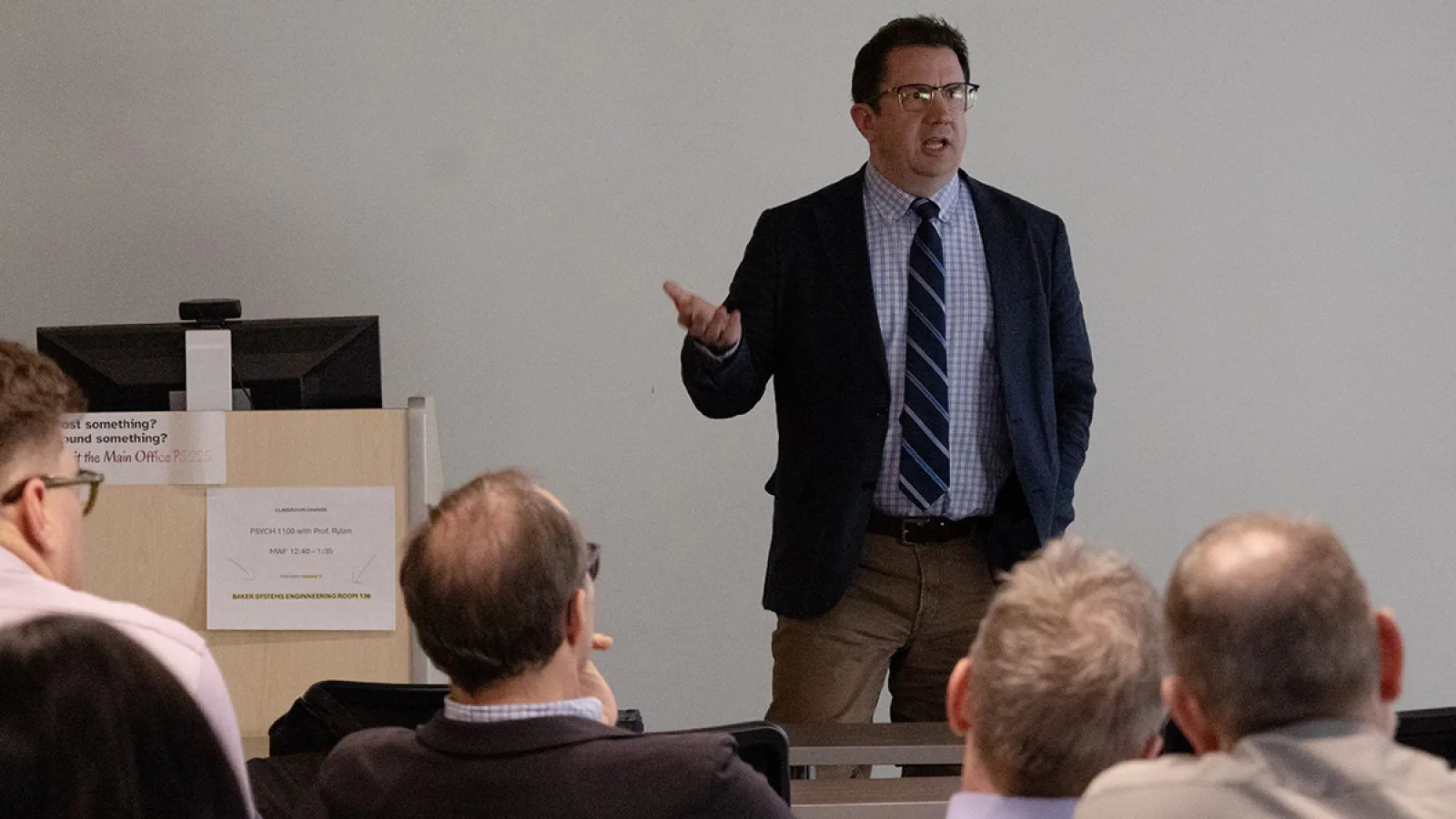
Traditional left-right models of politics may not explain America’s turbulent political landscape today, a prominent scientist told an Ohio State audience this month. Instead, rising levels of anti-establishment feeling could be to blame.
“It might actually be a rejection of the system outright,” Joseph Uscinski, a political science professor at the University of Miami, explained during a lecture in the Psychology Building on April 8.
He referenced a photo of a woman holding a protest sign: “Not Democrat, not Republican, just pissed.”
Uscinski discussed his theory as the first speaker of the C-SPAM Distinguished Scholars Colloquium Series, a program of the Collaborative on the Science of Polarization and Misinformation. A leading academic expert on conspiracy theories, he has spent the past 15 years studying a variety of misinformation-fueled ideas and beliefs that Americans hold.
It’s research that almost didn’t happen, he said. When a colleague first approached him about studying conspiracy theories in the early 2000s, he dismissed the idea.
Then 2016 arrived. Like many people who had paid attention only to establishment leaders and opinions, Uscinski was caught off guard by Donald Trump’s ascent to the presidency, he said. Since then, the professor has been busy polling everyday people and developing a new framework to understand the changing political landscape he has observed—one where violence is rising, longstanding institutions are breaking down and conspiracy theory has gone from fringe to mainstream.
"Instead of politics ... being a battle between elites on the left and elites on the right, it might be a battle between us, the good people, and them, the corrupt people who run everything."
“The question I want to ask is: Why are things breaking? Can we develop a theory to explain this?” he asked.
With most Americans no longer holding a consistent liberal or conservative identity, Uscinski proposes that our politics now involve an additional dimension: pro- and anti-establishment attitudes.
“Instead of politics for some people being a battle between elites on the left and elites on the right, it might be a battle between us, the good people, and them, the corrupt people who run everything, the corrupt establishment,” he said.
To illustrate his point, he displayed a series of Cartesian planes. Outsider candidates align themselves with anti-establishment sentiment on the left or right, then use this messaging to attract voters and gradually build a coalition, Uscinski explained.
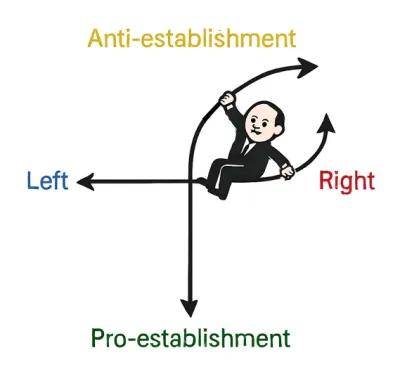
To retain support, mainline politicians then begin to adopt similar anti-establishment rhetoric and positions. Voters on both the left and right are pulled increasingly in pro- or anti-establishment directions. As inexperienced outsider candidates continue to enter the field, the effect snowballs, eventually resulting in institutional breakdown.
“Government will start to fail in some respects, because this class of leaders are just going to break things and they’re not going to be particularly good at building them,” Uscinski said.
A lively question-and-answer session followed his talk, which drew an interdisciplinary audience from units across campus, including the School of Communication and the Departments of Psychology, English and Political Science.
Dominik Stecula, an assistant professor in the School of Communication, said he appreciated the broad appeal of the event.
“He compellingly presented this big theory about American politics in an accessible way that spoke directly to scholars from different disciplines in the room,” Stecula said.
“I think the talk was theoretically rich, full of concrete examples, but also easy to understand and entertaining, which is not something you see in academic talks a lot.”
Helen Murphey, a postdoctoral scholar with the Mershon Center for International Security Studies, said Uscinski’s talk offered “crucial” insights about the spread of anti-establishment sentiment and the erosion of institutional trust. The research resonated with her own work on populism.
Uscinski’s visit also offered valuable networking opportunities for her and other C-SPAM affiliates, including one-on-one research meetings with the speaker. Murphey and Uscinski discussed the growth of conspiracy theories internationally and how these beliefs affect trust in international organizations and cooperation, she explained.
Overall, Uscinski’s visit marked a successful start to the C-SPAM Distinguished Scholars Colloquium Series, said Kurt Gray, the collaborative’s faculty director and a professor in the Department of Psychology.
“It was a fantastic opportunity for the Ohio State community—from graduate students to professors—to learn and engage,” he said.
C-SPAM will continue the program this autumn. Invited speakers include Brendan Nyhan, the James O. Freedman Presidential Professor at Dartmouth College, and Jamie Druckman, a professor of political science at the University of Rochester.